Co-managed IT services let an internal team keep control while adding the expertise, coverage, and project muscle it cannot staff for on its own.
The cybersecurity and IT skills gap is structural, not temporary, so hiring your way out of it is slow and expensive.
Co-management is a division of labor, not a takeover: your team keeps the work it does best and hands off the rest.
The model shines for specialized security work, after-hours coverage, large projects, and long-term strategy.
Understaffed organizations pay measurably more when something goes wrong, which is exactly what co-management is built to prevent.
If your IT team is capable but constantly behind, the fix is usually more reach, not more headcount.
Most internal IT teams are not failing. They are outnumbered. A two- or three-person department can keep a 200-person company running day to day, but the same team is also expected to patch every system, answer every ticket, run cloud migrations, satisfy auditors, and stay ahead of attackers who work nights and weekends. Something has to give, and it is usually the strategic work that never feels urgent until it is.
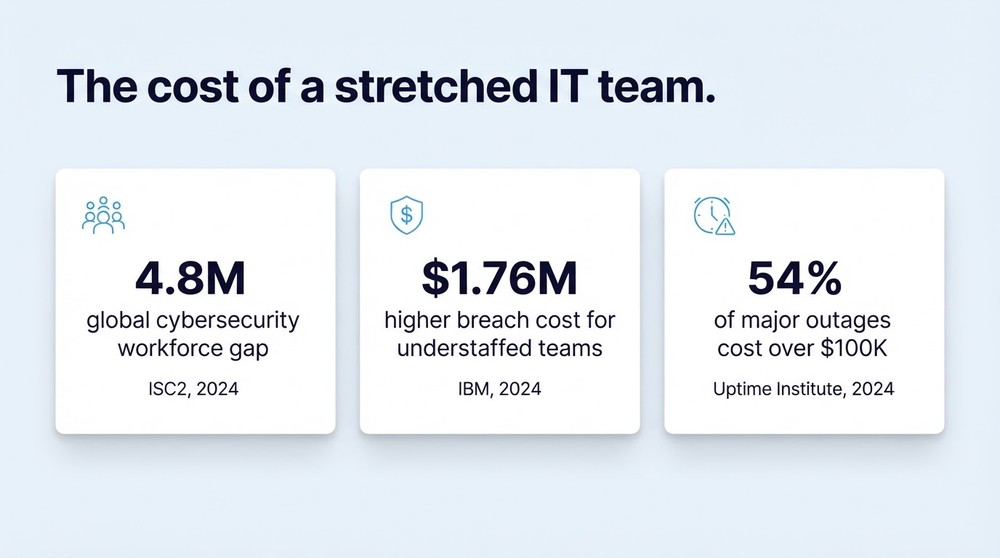
The talent math is not on your side. The world is short 4.8 million cybersecurity professionals, a gap that grew 19 percent in a single year, per the ISC2 2024 Cybersecurity Workforce Study. Good luck hiring your way out of that in a regional market: the search is slow, the salary is national even when your market is not, and the best people are already taken. This is the gap that co-managed IT services are designed to close. Instead of replacing your team, a partner reinforces it.
What Are Co-Managed IT Services, Exactly?
Co-managed IT services are a shared support model where an outside provider and your in-house staff split responsibility for the technology environment. Your team keeps the institutional knowledge, the user relationships, and the work it wants to own. The partner supplies specialized skills, tools, and capacity where the internal team is stretched or missing coverage entirely.
The key word is shared. This is not a quiet handoff. Roles get defined deliberately: who owns the help desk, who handles escalations, who runs patching, who leads security. A sound arrangement documents those boundaries so nothing falls through the cracks. It pairs naturally with co-managed IT support that can flex from light-touch to full coverage as needs shift over time.
Why Do Internal IT Teams Hit a Ceiling?
Internal teams hit a ceiling because breadth and depth pull in opposite directions. A small team can be broad or deep, rarely both at once. The same people running the help desk are the ones expected to architect a cloud migration and interpret a compliance framework, and there are only so many hours in a week.
The strategic work is always what loses. Tickets scream and roadmaps whisper, so the roadmap waits, quarter after quarter. CIO's reporting makes the same point: IT leaders increasingly have to defend high-value work from being buried under low-impact maintenance. This is where internal IT team support from an outside partner changes the equation. When one person owns backups, another owns the firewall, and both sit on the same PTO calendar, a single vacation or resignation quietly becomes a risk event.
Thin coverage gets expensive the moment something breaks. Understaffed teams pay about 1.76 million dollars more when a breach hits, on top of a global average that already reached 4.88 million dollars, per IBM's Cost of a Data Breach 2024 report. The gap on your org chart has a price, and you pay it on the worst day.
Fully Managed vs. Co-Managed IT: Which Model Fits?
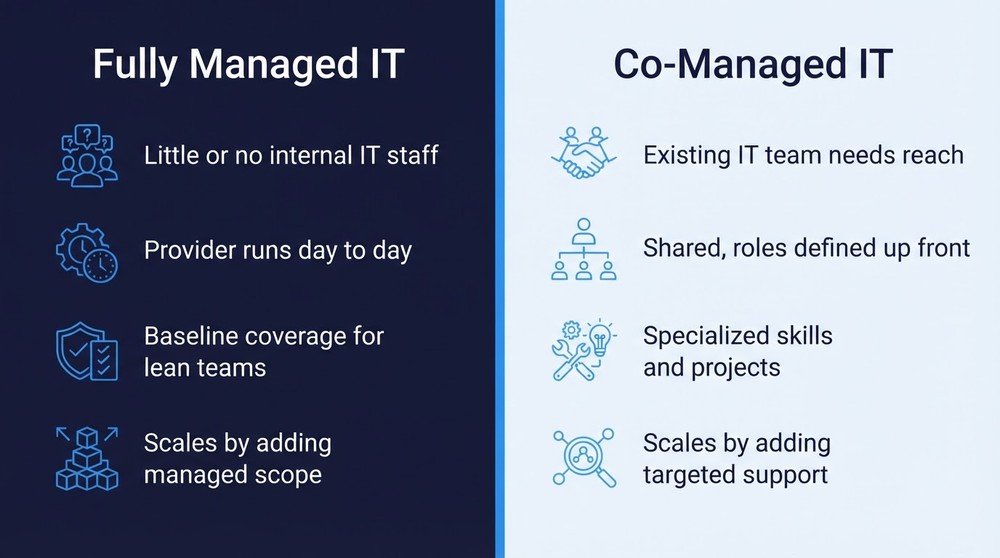
The difference comes down to how much you want to own. Fully managed hands the whole environment to a provider, effectively running as your outsourced IT department. Co-managed keeps your internal team in the driver's seat and fills specific gaps around them.
Smaller organizations with little or no IT staff often choose fully managed, because there is no internal team to build around. Organizations with capable staff who simply need more reach tend to prefer co-management. Neither is better in the abstract. They solve different problems.
The choice comes down to a few dimensions:
Best fit. Fully managed suits a business with little or no internal IT staff; co-managed suits an existing IT team that needs more reach.
Day-to-day ownership. Fully managed means the provider runs it; co-managed shares the work with roles defined up front.
Internal control. Fully managed lowers it by design; co-managed keeps it high, with your team in the lead.
Typical use. Fully managed provides baseline coverage for a lean shop; co-managed adds specialized skills, projects, and coverage.
How it scales. Fully managed scales by adding managed scope; co-managed scales by adding targeted support where needed.
A practical way to choose: if you would struggle to name who owns patching today, fully managed may be the safer baseline. If you can name every owner but they are all underwater, co-managed IT services are usually the better fit.

5 Ways Co-Managed IT Services Extend an Internal Team
Here are the gaps co-managed IT services most often fill, in roughly the order teams tend to feel them.
Specialized expertise on demand. Few internal teams can staff full-time experts in cloud architecture, identity, and compliance all at once. Co-management gives access to those specialists only when a project or problem actually calls for them, which is far cheaper than carrying them on payroll year round.
Surge capacity for projects. Migrations, office moves, and security rollouts spike the workload well above the daily baseline. A partner absorbs the spike so the internal team is not forced to choose between the project and the ticket queue.
After-hours and holiday coverage. Attackers and failing hardware do not keep business hours. Shared monitoring means someone is watching at 2 a.m. without asking your staff to carry a pager every night of the year.
Strategic direction. Someone has to own the multi-year roadmap, the budget forecast, and the risk conversation with leadership. This is where virtual CIO guidance adds a strategic layer many lean teams cannot fund as a full-time hire.
Cybersecurity depth and incident response. Detecting and containing a breach quickly takes both tools and practiced people. Co-management adds cybersecurity resources and a response capability that most internal teams cannot build alone.
Put simply, co-management maps to the gaps most internal teams share:
Security monitoring. Where there are no after-hours eyes, it adds 24/7 shared coverage.
Compliance prep. Where framework expertise is thin, it adds assessment and remediation support.
Cloud and Microsoft projects. Where peak workload overwhelms the team, it adds surge capacity and specialists.
Strategy and budgeting. Where there is no dedicated CIO, it adds virtual CIO guidance.
A short worked example makes the coverage point concrete. The Uptime Institute Annual Outage Analysis 2024 found that 54 percent of organizations said their most recent significant outage cost more than 100,000 dollars. If an unmonitored system fails on a Friday night and is not caught until Monday morning, that is roughly 60 hours of exposure. Even at a conservative, illustrative rate of 1,000 dollars per hour in lost productivity and recovery, the weekend gap alone approaches 60,000 dollars, before counting reputation or compliance fallout. Shared monitoring exists to turn that 60 hours into minutes.
How Do You Know If Co-Management Is Right for You?
Start by looking at your patterns, not your org chart. Co-managed IT services fit best when your team is skilled but consistently out of hours, depth, or coverage.
A few signals point clearly toward co-management: projects keep slipping because daily tickets always win, one or two people have become single points of failure, security and compliance work keeps getting deferred, or leadership wants a technology strategy that no one has time to write. The assess-first principle matters here. Before buying anything, map where your real exposure actually sits, because the honest answer often shows the gap is narrower and cheaper to fill than a full outsource. For regulated operators in manufacturing and healthcare, that mapping is where co-management earns its keep, since the cost of a compliance miss dwarfs the cost of the support.

Frequently Asked Questions
Is co-managed IT the same as staff augmentation?
Not quite. Staff augmentation rents you hands to complete defined tasks. Co-management shares ownership and accountability for outcomes, including strategy and security, not only labor.
Will a managed IT provider try to replace your IT staff?
A bad one might angle for it. A good one is built around your team and takes the work they should not have to own. If a provider's pitch is hand us everything, that is a fit question worth asking out loud.
How are co-managed IT services priced?
Most models use a predictable monthly subscription, typically a baseline plus add-ons for the areas you actually need. Specifics depend on your device count, users, and coverage level, so pricing should follow an assessment rather than precede it.
Can we start co-managed and move to fully managed later, or the reverse?
Yes. The model is meant to flex. Many organizations shift the balance over time as staff join or leave, or as major projects come and go.
Does co-management work for regulated industries?
It is often where the model fits best. Manufacturing and healthcare face frameworks like CMMC and HIPAA that demand depth few internal teams carry, and co-management supplies that expertise without replacing the people who know the business.
Reinforce Your Team Instead of Rebuilding It
If your internal team is strong but stretched, the answer is rarely a bigger payroll. It is a partner who fits into how you already work. Centaris is an IT and cybersecurity partner serving manufacturing, healthcare, and other regulated organizations across Michigan and the greater Great Lakes region, and its co-managed and fully managed models are built around exactly this problem. The Centaris Way starts with an assessment, not a sales pitch: understand where you actually stand, then reinforce only where it counts. If you want to see where the gaps are, schedule a no-obligation assessment and start from the facts.