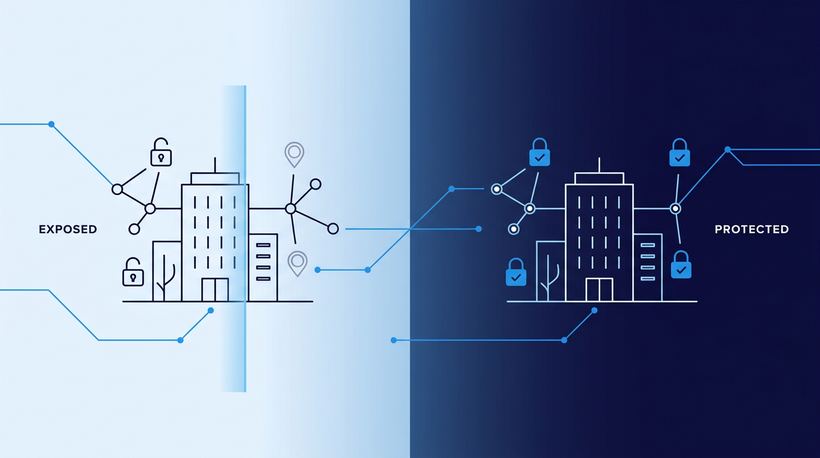
Most organizations do not have a technology problem. They have a decision problem, and no one is senior enough to own it.
Technology decisions get made in Michigan organizations every week, usually by whoever is closest to the fire.
Executive-level technology guidance is now a governance expectation, not a luxury. NIST added Govern as a top-level function of the Cybersecurity Framework in 2024, and CISA followed in its own baseline guidance.
The security talent gap makes a full-time CIO or CISO hire impractical for most organizations with 100 to 1,000 employees.
Unplanned capital, duplicate software, and deferred replacements are budget problems created by the absence of a roadmap, not by the price of technology.
A virtual CIO produces artifacts an owner or board can act on: a roadmap, a budget, a risk register, and a vendor list with owners attached.
If no one in your organization can name the top three technology risks and what they cost, that gap is the first thing to fix.
Most mid-sized organizations do not lack technology. They lack a plan for it. Servers get replaced when they fail, security tools get purchased after an incident or an audit, and software renewals get approved because canceling them feels riskier than paying for them. Every one of those decisions is defensible in isolation. Together they produce an environment nobody designed.
That gap has a name now. When NIST released version 2.0 of its Cybersecurity Framework in February 2024, it added Govern as a sixth core function, elevating strategy, roles, and accountability to the same level as the technical controls underneath them. The message was direct: someone has to own the decisions, and that ownership is not a technical task.
For organizations between roughly 100 and 1,000 employees, hiring that person is rarely realistic. Virtual CIO services in Michigan exist to close the distance, providing executive-level technology leadership on a recurring cadence instead of a payroll line.
What Are Virtual CIO Services in Michigan?
Virtual CIO services in Michigan provide fractional access to a senior technology executive who owns planning, budgeting, risk, and vendor strategy for your organization without joining it full time. The role is advisory and accountable rather than hands on. A virtual CIO does not reset passwords or rebuild a failed server. A virtual CIO decides whether that server should exist next year, what replaces it, when the money is spent, and what happens to the risk in the meantime.
The distinction matters because most organizations already have technical help. What they lack is someone translating between the server room and the boardroom. A virtual CISO fills the same seat with a sharper security and compliance focus, and in regulated environments the two roles overlap heavily.
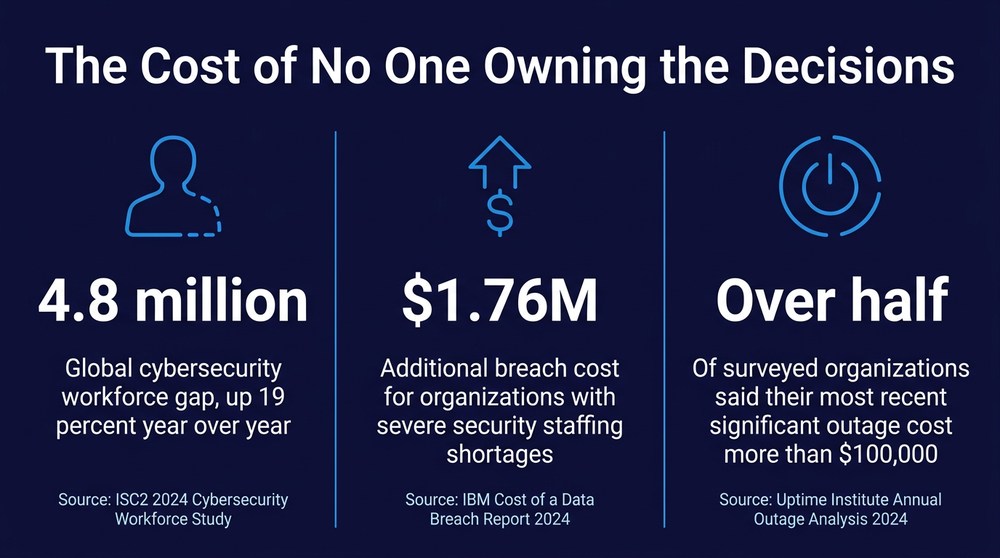
The talent math explains why the model exists at all. The ISC2 2024 Cybersecurity Workforce Study put the global cybersecurity workforce gap at 4.8 million people, a 19 percent increase year over year. Michigan organizations competing for that talent are competing with Detroit automotive, regional health systems, and every national firm recruiting remotely at a salary you were not planning to match.
Why Does Technology Strategy Break Down First?
Strategy breaks down first because it is the only technology function with no alarm attached to it. A failed backup generates a ticket. A missed roadmap generates nothing until the day it matters.
The pattern is consistent. Tools get bought and never validated. Compliance and IT run as separate conversations, and the gaps live in between. Nobody owns the outcome, so nobody reports on it. Ask most organizations who is accountable for patching, and the honest answer is a shrug in the direction of a vendor.
That silence gets expensive in two directions. On the security side, IBM's Cost of a Data Breach Report put the 2024 global average at 4.88 million dollars and found that organizations with severe security staffing shortages paid roughly 1.76 million dollars more per breach than those without that gap. On the operations side, more than half of the respondents to the survey behind the Uptime Institute's Annual Outage Analysis 2024 said their most recent significant outage cost over 100,000 dollars. Neither figure describes a technology failure. Both describe a governance failure with a technical trigger.
Software spend follows the same shape. Organizations pay year after year for licenses nobody logs into, overlapping tools bought by different departments, and renewals that process automatically because no one owns the review. That waste does not come from bad purchases. It comes from purchases nobody looked at again.
What Does a Virtual CIO Actually Do?
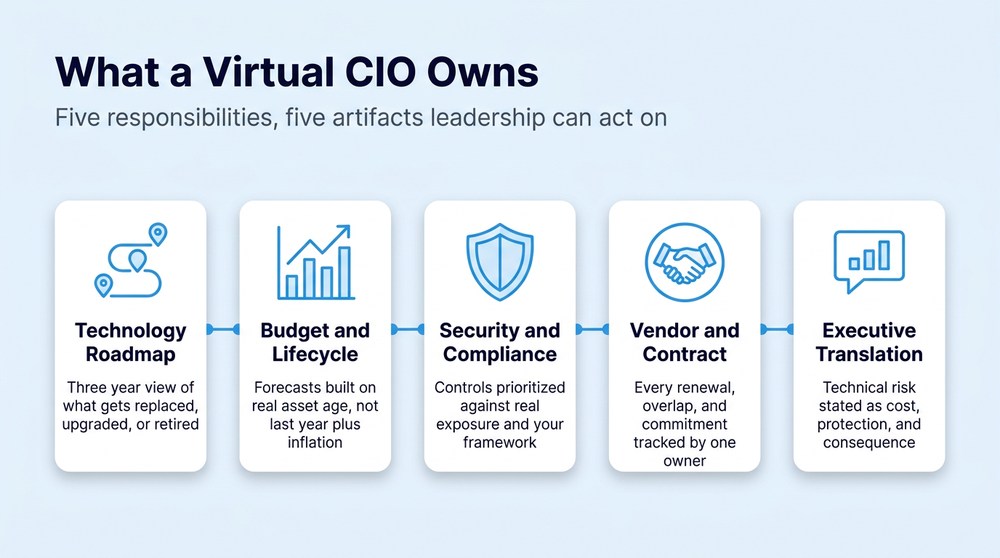
A virtual CIO owns five things that otherwise fall between your internal staff, your support provider, and your leadership team. Each produces an artifact you can hand to a lender, an insurer, or a board.
1. The technology roadmap. A three-year view of what gets replaced, upgraded, retired, or consolidated, with dependencies mapped. This converts a hundred small decisions into a sequence. Without it, urgency sets priority, and urgency is a poor planner. AI belongs on this roadmap as a governance question before it becomes a productivity question: which tools are approved, what data they are allowed to touch, and which policy covers the employee who pasted a contract into a chatbot last Tuesday.
2. Budget and lifecycle planning. Capital and operating forecasts built on actual asset age and support dates rather than last year's number plus inflation. The point is predictability. Leadership should never learn about a 200,000 dollar refresh in the same meeting where it is approved.
3. Cybersecurity strategy and compliance alignment. Prioritizing controls against real exposure and against the framework your industry actually answers to, whether that is CMMC, HIPAA, TISAX, or CJIS. A layered cybersecurity program only works if someone sequences the layers. CISA's Cross Sector Cybersecurity Performance Goals offer a defensible starting order, and version 2.0 added its own governance component in December 2025 for the same reason NIST did.
4. Vendor and contract management. One person tracking every technology contract, renewal date, overlap, and performance commitment. This is where the software waste above gets recovered, and where a stalled provider relationship gets addressed before the renewal quietly extends it another year.
5. Executive translation. Turning technical risk into business language: what it costs, what it protects, what happens if it waits. Most technology budgets fail in the room, not on the spreadsheet.
How Do Virtual CIO Services in Michigan Change the Way You Budget?
They change the timing of spend more than the amount of it, and timing is usually what breaks the budget.
Consider a 220-employee manufacturer that bought its workstation fleet in a single wave. That fleet will reach end of life in a single wave too. At an illustrative 1,200 dollars per device, replacement lands as roughly 264,000 dollars in one quarter. Spread across a four-year rolling refresh, the same fleet costs about 66,000 dollars a year and never surprises anyone. Total hardware cost barely moves. What changes is the pressure to defer a replacement that is already overdue, which is how organizations end up running unsupported operating systems on a plant floor.
Quarterly. Focus: Roadmap progress, incidents, project status. Output leadership receives: Updated risk register and priority list.
Annually. Focus: Budget, lifecycle forecast, vendor review. Output leadership receives: Capital and operating plan with justification.
As triggered. Focus: Audits, acquisitions, new facilities, incidents. Output leadership receives: Impact assessment and revised sequence.
The cadence is the product. A single strategy session produces a document. A standing cadence produces decisions that hold.

What Do Virtual CIO Services in Michigan Look Like in Regulated Industries?
They look less like general technology consulting services and more like sustained regulatory pressure management, because that is what manufacturing and healthcare organizations across the Great Lakes region are actually navigating.
A manufacturer in a defense supply chain does not need a generic IT strategy consulting engagement. It needs someone who understands that CMMC Level 2 certification is issued by an accredited third party assessor, that implementation and assessment are separate roles filled by separate parties, and that technical work has to be sequenced against production schedules rather than a consultant's calendar. It needs someone who has secured USB ports on a shop floor and knows why a blanket policy fails there. That is domain knowledge, and it does not transfer cleanly from a national playbook into manufacturing environments.
Healthcare carries the same structure with tighter tolerances. HIPAA obligations sit alongside connected clinical devices that cannot be patched on a normal cycle, vendor risk assessments arriving from every payer and partner, and downtime windows measured against patient schedules rather than shift changes. A roadmap for a healthcare organization has to account for equipment the IT team is not permitted to touch and workflows clinicians will bypass if security makes them slower. Someone has to hold both realities at once and still produce a plan a compliance officer will sign.
Proximity matters more here than it does on a spreadsheet. Someone who can walk your plant floor or your clinical wing in the morning sees failure modes that never surface in a remote monitoring dashboard.

What Separates Strategic Guidance From a Sales Conversation?
The test is simple. Strategic guidance starts with an assessment and produces a prioritized list, some of which you will decline. A sales conversation starts with a product.
Starting point. Reactive provider relationship: Your stated symptom. Virtual CIO oversight: Assessment of the full environment.
Purchase logic. Reactive provider relationship: Tool solves the immediate issue. Virtual CIO oversight: Control addresses a ranked risk.
Budget horizon. Reactive provider relationship: Current quarter. Virtual CIO oversight: Three years, revisited quarterly.
Vendor stance. Reactive provider relationship: Renewal by default. Virtual CIO oversight: Contract reviewed against performance.
Reporting. Reactive provider relationship: Ticket volume and uptime. Virtual CIO oversight: Risk position and roadmap progress.
Compliance. Reactive provider relationship: Handled separately, often late. Virtual CIO oversight: Sequenced into the plan.
The model works alongside internal staff rather than replacing them. A two-person IT team that spends its week on tickets is not failing at strategy. It never had room for strategy. Pairing that team with executive guidance and co-managed IT support gives them a roadmap they can execute against, and gives leadership someone accountable for the direction.
Frequently Asked Questions
What is the difference between a virtual CIO and a virtual CISO?
A virtual CIO owns overall technology strategy, budgeting, and vendor management. A virtual CISO focuses specifically on security posture, risk, and compliance alignment. In regulated industries the two roles are frequently combined, since nearly every technology decision carries a security consequence.
Can a virtual CIO work with an internal IT team?
Yes, and that is the most common arrangement above roughly 150 employees. The internal team retains operational control while the virtual CIO handles planning, budget defense, vendor negotiation, and risk reporting.
Does a virtual CIO make an organization compliant?
No. A virtual CIO assesses gaps, builds a remediation plan, and prepares an organization for assessment. Formal certification under frameworks like CMMC or TISAX is issued by accredited third parties, and compliance readiness work is preparation for that review, never a substitute for it.
How do vCIO services in Michigan differ from project-based business technology consulting?
Consulting engagements are typically scoped to a deliverable and end when it ships. A vCIO relationship is continuous, carries ongoing accountability for the roadmap and the risk register, and is measured on decisions executed rather than recommendations delivered.
How quickly does a virtual CIO engagement produce results?
The first assessment and prioritized gap list typically arrive within the first several weeks. Budget and roadmap artifacts follow the first full planning cycle. Measurable risk reduction depends on which items leadership chooses to fund and in what order.
See Where You Actually Stand
Every organization already has a technology strategy. Most of them just have not read it, because it was written one emergency at a time by whoever happened to be available.
Centaris is an IT and cybersecurity partner serving manufacturing, healthcare, and other regulated organizations across Michigan and the Great Lakes region. Our approach starts with assessment rather than a proposal: we look at what you have, show you where the exposure sits, and let you decide what to address and in what order. That is the foundation of the strategic technology guidance behind our virtual CIO and virtual CISO engagements, delivered by people who can be on site when the conversation calls for it.
Schedule a no-obligation assessment and start with a clear picture of where you stand.